Brands There are 49 brands

D.O. MONTSANT
Montsant is a designation of origin established in 2002 and made up of the municipalities and wineries that, until that date, formed the Falset sub-area of the Tarragona designation of origin. It is spread over 16 municipalities, the majority in the Priorato region and a few in the Ribera del Ebro. It produces around 5 million bottles a year, of which half is destined for export (mainly to Germany and the United States). The area of vineyards planted is almost 1,900 hectares that are distributed over 50 wineries.3
D.O. PENEDES
Penedés (in Catalan, Penedès) is a Spanish denomination of origin that takes its name from the Catalan region of Penedés. The cultivation area is 27,542 ha. It includes 47 municipalities in the south of the province of Barcelona, and 16 municipalities in the province of Tarragona.
The production of the best cava in the world predominates in this region. In addition, its white wines are famous. They are light, aromatic, low-bodied wines. It also produces sparkling wine and rosé. It has a small production of red wine.
D.O. RIAS BAIXAS
Rías Baixas is one of the five designations of origin for wine in Galicia (Spain). It was created in 1980 as a specific denomination and in 1988 it was recognized as a denomination of origin.
The vineyards cover an area of around 2,700 hectares, which belong to 180 wineries. This denomination is the largest Galician producer, since 55 of its wineries produce more than 25,000 liters and some twenty exceed 75,000. Total production exceeds 10 million liters.
D.O. RIBEIRO
The Ribeiro Designation of Origin, or Ribero wine, which means "river bank" in Galician, is one of the five existing wine designations of origin in Galicia. The production area is located in the southern part of Galicia, on the northwestern edge of the province of Orense, at the confluence of the valleys formed by the Miño, Avia, Arnoia and Barbantiño rivers. The mountainous edges isolate this region from the Atlantic maritime influence, which determines its lower rainfall. The climate is temperate and humid, with average temperatures of 14.5 degrees Celsius. The lands are mostly of granite origin and, in general, acidic.
In 1925 it had about 6000 hectares of vineyards, ninety years later, in 2016, it had a total area of 2646 hectares of vineyards are made up of lands that are in the following municipalities and places: town councils of Ribadavia, Arnoya, Beade, Carballeda de Avia, Castrelo de Miño, Cenlle, Cortegada, Leiro and Pungín; the parishes of Banga, Cabanelas and Varón, in the municipality of Carballino; the parishes of Pazos de Arenteiro, Albarellos, Lajas, Cameija and Moldes in the municipality of Boborás; the places of Santa Cruz de Arrabaldo and Untes in the town hall of Orense, and from the town of Toén the places of Puga, A Eirexa de Puga, O Olivar, the town of Feá and Celeirón and the parish of Alongos; and the town of A Touza from the San Amaro town hall.
The wines of this denomination respond to a series of combinations of exquisite fruity and floral aromas, which are almost always surprising when made with traditional indigenous varieties (Treixadura, Torrontés, Loureira, Caíño tinto, Brancellao, Sousón) and have a marked personality that becomes incomparable. Ribeiro white wines are light, fresh, dry, fruity, pale straw in color, high fixed acidity and with a minimum alcohol content of 11º (Ribeiro Castes) .1 Ribeiro red wines are reddish-purple in color and balanced with acidity, with a minimum alcohol content of 11º (Ribeiro Castes) .1 The minimum alcohol content of barrel wines is set at 12º.1 5
0 products
D.O. VALLADOLID
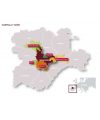
Valladolid's wines and wineries are part of the local culture and have become a great tourist attraction. The most important wines of Valladolid are Ribera del Duero in reds, Rueda in whites and Cigales in rosés. To a lesser extent, the Toro wines are also noteworthy.
0 products

D.O. WASHINGTON
American wine has been produced for more than 300 years. Currently, wine production takes place within the fifty states, with California being the leader in wine production, along with Washington, Oregon and New York.1 The United States is the fourth largest wine producer in the world, with 22.5 million hectoliters, after Italy (48.8 million hl), France (41.9 million hl), and Spain (37.8 million hl), and ahead of Australia (12.5 million hl) .2
The North American continent is home to a number of native grape varieties, including Vitis labrusca, Vitis riparia, Vitis rotundifolia, Vitis vulpina, and Vitis amurensis, but it was the introduction of the European Vitis vinifera by European settlers that led to the growth of the wine industry.3 With more than 4500 km² of vines, the United States is the fifth country with the most vines planted in the world, after France, Italy, Spain and Turkey.4

FRANCIA BORDEUX
The Bordeaux vineyard (in French, Vignoble de Bordeaux) is a French wine region that stretches across western France, in the New Aquitaine region. Bordeaux wines (vins de Bordeaux) are made in some 9000 wineries, usually called châteaux if they are associated with a specific vineyard, with grapes from around 14,000 wine producers, 117,514 hectares of vineyards, 400 merchants and a turnover of 14,500 million euros. There are 57 controlled appellations of origin for Bordeaux wine.
More than 700 million bottles of Bordeaux wine are produced each year, in a variety of qualities, from ordinary table wines to some of the most expensive and prestigious wines in the world. Most Bordeaux wines are red, but sweet white wines of noble rot have also contributed to the reputation of the region, and dry white, rosé and sparkling wines (Crémant de Bordeaux) are also produced.

FRANCIA LOIRE
The Loire Valley vineyard (in French, Vignoble du Val-de-Loire) is a French wine region located along the course of the Loire River, from the Atlantic to the Massif Central. All regions are located on the banks of the Loire and its tributaries.
Most of the production is dry, semi-dry, sweet and even liquor white wine, made from chenin blanc grapes, sauvignon blanc and Burgundy melon. But light reds are also made (especially around the Chinon region) with cabernet franc. In addition, rosé and sparkling wines are produced. Loire wines, in general, tend to exhibit a fruity character with fresh flavors, especially when young.1 This region already had vines in the 1st century, and in the High Middle Ages, its wines were the most esteemed in England and France, even more than those of Bordeaux.2 The entire region includes 87 appellations, between quality wines (AOC and AOVDQS) and wines from the country.

FRANCIA PROVENCE
The vineyard of Provence (in French, Vignoble de Provence) is a French wine region that stretches from the south of Avignon to the Alpes-Maritimes (vineyard of Bellet sur Nice). It is characterized by a great heterogeneity in both its geological and climatic situation, although with a predominant Mediterranean climate; there are colder areas where the influence of the wind will be decisive.
Within this vineyard the following appellations of origin (AOC) are recognized:
LANZAROTE
Lanzarote is a wine region with a designation of origin (DO), located on the island of Lanzarote in the Canary Islands (Spain). It obtained the qualification of denomination of origin in 1993.3 It covers a total cultivation area of 1,900 ha, and its production is around one million nine hundred thousand bottles per year (2010) .4